Soccer Ball Size by Age: The Complete Guide to Sizes 1–5, Surfaces and What to Buy
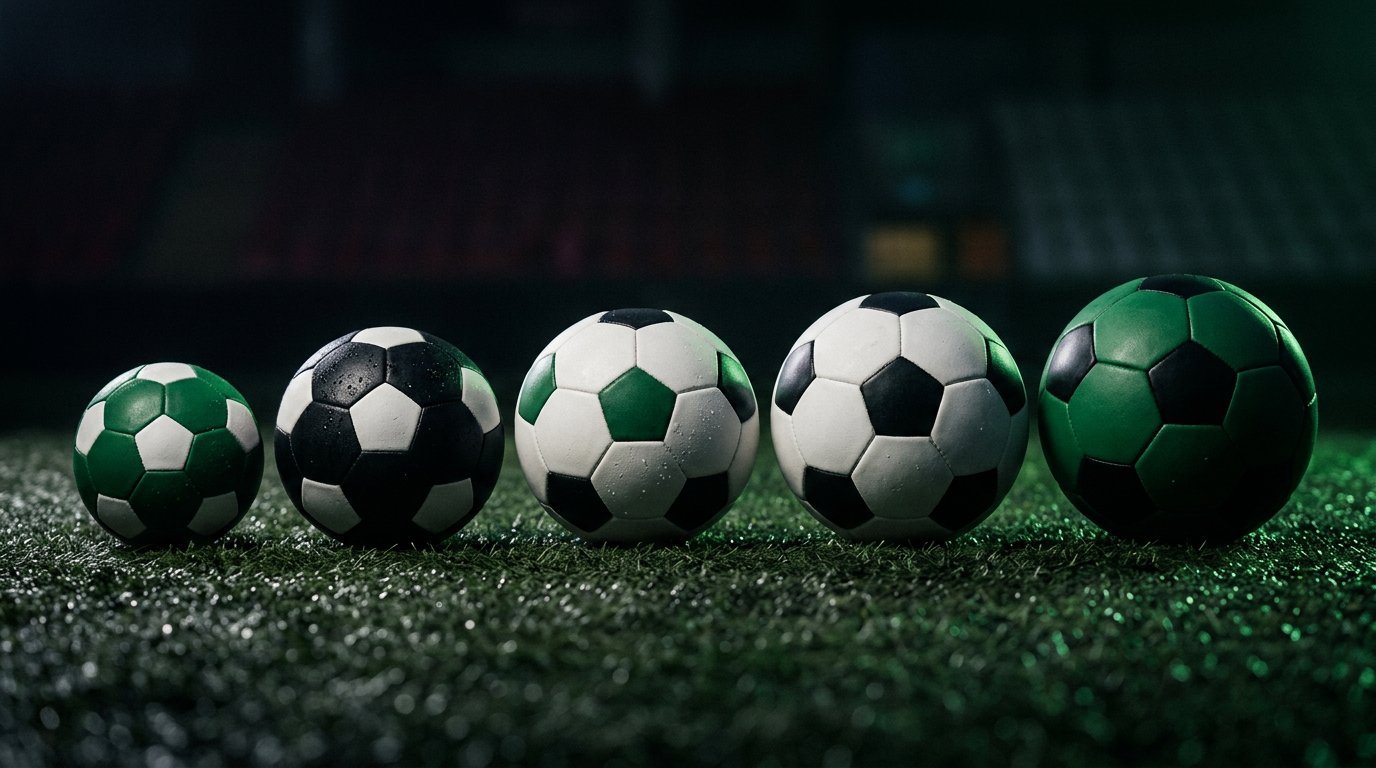
A ball that is too big for a child does more damage than most parents expect: it teaches a heavy first touch, it makes shooting technique collapse into toe-pokes, and it takes the fun out of the one thing that keeps kids playing. A ball that is too small for a teenager is just as bad in the other direction. This guide covers the official size for each age group, what the construction labels actually mean, which ball survives each surface, and which ones are worth your money right now.
Ball sizes by age: the quick table
Sizes are standard across federations. Clubs in the United States and the United Kingdom follow the same thresholds, with small local exceptions.
| Size | Age group | Circumference | Weight | Typical use |
|---|---|---|---|---|
| 1 | Any age | 18–20 in (46–51 cm) | 7–8 oz | Skills ball, collectible, first touches for toddlers |
| 3 | Under 8 | 23–24 in (58–61 cm) | 10–12 oz (300–320 g) | First proper ball, U6 and U8 leagues |
| 4 | 8 to 12 | 25–26 in (63.5–66 cm) | 12–13 oz (350–390 g) | U9 to U12 leagues, also futsal (with a low-bounce bladder) |
| 5 | 12 and over | 27–28 in (68–70 cm) | 14–16 oz (410–450 g) | Teenagers, adults, all professional football |
Size 2 exists, but it is rare and mostly sold as a promotional or skills ball. If a club lists "size 2" for U4, a size 1 or 3 will do the job.
When to move up a size
Move on the birthday that matches the league rules, not before. The common mistake is to buy a size 5 for an eleven-year-old "so it lasts". It will not be used properly for a year, and the player will spend that year adapting to a ball that is too heavy for their technique. The reverse happens less, but a fourteen-year-old still training with a size 4 will struggle with the weight and flight of match balls when they step up.
If a child is between age groups and plays up with older kids, buy the size of the league they play in most weekends. Keep the smaller ball for garden skills work; it is still useful.
Match ball, training ball or skills ball: what the labels mean
Manufacturers use three tiers, and the price difference is real.
- Match balls are thermally bonded (no stitching), with a textured polyurethane cover and a latex bladder. They fly truest and feel softest, but latex bladders lose air within days and the cover scuffs on concrete. Buy one for games only.
- Training balls are machine-stitched or glued, with a thicker TPU or PU cover and a butyl bladder that holds pressure for weeks. This is the ball to buy for most children and for anyone training on turf.
- Skills balls (size 1 and some size 3) are for juggling and close control. They are not for matches.
FIFA Quality and FIFA Quality Pro marks mean the ball passed tests for circumference, weight, water uptake and rebound. They matter for match balls; for a training ball a solid construction matters more than a badge.
Which construction survives which surface
Surface wears a ball faster than age does.
- Natural grass: anything works. A machine-stitched training ball lasts a season or more.
- Artificial turf: rubber infill abrades glued covers; look for thermally bonded or hand-stitched training balls with a thick textured cover.
- Concrete, asphalt, street: only balls with a rubber or heavy TPU cover. Match balls are destroyed in weeks here.
- Indoor hall or futsal: a futsal ball (size 4, low bounce) protects the floor and the technique.
Our picks
These are the categories we would buy for each case. The links open current Amazon results so you can check today's price and stock.
Size 3 machine-stitched training ball
For under-8s: durable cover, butyl bladder, light enough for proper technique.
Size 4 training ball with textured cover
The size most leagues use between U9 and U12; textured covers grip better in wet conditions.
Thermally bonded size 5 training ball
No stitching to fray on rubber infill; the right buy for teens training on artificial pitches.
Size 5 street ball with rubber cover
Built for concrete and asphalt; heavier feel, lasts for years.
Futsal ball size 4, low bounce
Keeps the ball on the floor indoors and sharpens close control.
Ball pump with pressure gauge
Correct pressure every session; stops balls going dead or rock-hard.
Pressure, pumps and care
Most training balls want 8.5 to 15.6 psi (0.6 to 1.1 bar); the exact range is printed near the valve. Under-inflated balls feel dead and wear faster; over-inflated ones hurt small feet. A pump with a built-in gauge costs little and stops the guessing. Wipe mud off before it dries, never leave a ball in a hot car, and store it half-deflated if it will not be used for months.
How many balls does a young player need?
Two: one for the pitch and one that stays clean for indoor touches and garden work. If the player trains alone, a third ball saves a lot of walking.
Are expensive balls better for children?
Not until they play competitive matches. A good training ball at the correct size does more for technique than a match ball that gets scuffed on the driveway.
Need the right size for a specific player? Use the ball size tool in the Gear Lab: enter the age and surface and it tells you what to buy.
Comments
Post a Comment